From backyard to business: the shared returns of improved poultry practices
When Ana* brought home her first fifty broiler chicks, she set them up in a spare room of her house in rural Mozambique. She had limited formal training, Ana saw her poultry business as a secondary activity, redirecting any revenue to household expenses rather than reinvesting. A few cycles in, she enrolled on a training course run by Transurban, an AgDevCo investee operating across the region. Her flock grew. Her mortality rates fell. Her margins improved. Today, two of her children are studying at university abroad — paid for, in part, by chickens.
Ana's trajectory isn't guaranteed for every smallholder who picks up a few chicks. But it is achievable, and it happens reliably when farmers have the right knowledge and the right support behind them. That makes reaching this outcome as much a business imperative as a development one.
"Anyone can grow chickens. But the question is: how well? How fast? What is your mortality at the end of the cycle? That's the difference between a good grower and a bad grower," says Jamila, Transurban's General Manager. It's a distinction that shows up in the data and in lives like Ana's.
What the training changed
Between 2021 and 2025, AgDevCo's Technical Assistance Facility supported projects with two poultry investees, Transurban in Mozambique and Uzima in Uganda, aimed at equipping smallholder farmers with practical skills and ongoing technical support. The portfolio of poultry businesses combines high-quality inputs, better access to markets, and the kind of follow-up that turns a one-off training into a lasting change in practice.
The results are striking. Farmers who completed Transurban's intensive training more than doubled their adoption of good poultry practices. Revenues rose by 51%. Profits increased by around a third. For farmers like Ana, those percentages translate into school fees paid on time, a second flock added, a small business that suddenly looks like a serious one.
In Uganda, 94% of farmers engaged with Uzima reported an increase in total income. And the change reached beyond the balance sheet: women described earning more, yes, but also gaining confidence, reinvesting in new ventures, and reshaping their role within their households.
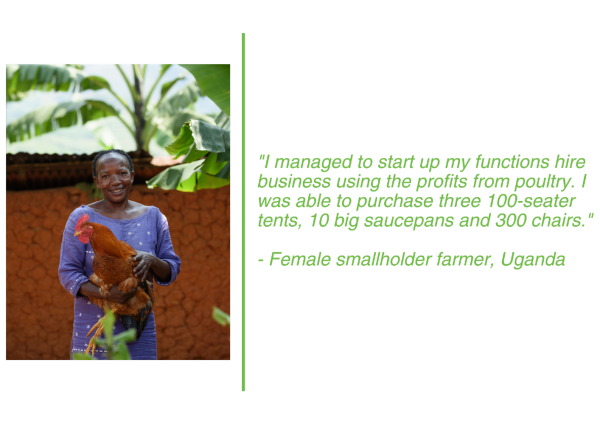
When farmers thrive, the businesses they sell to and buy from thrive alongside them. Better practices mean more consistent orders, stronger loyalty, and a customer base that grows with the business.
Women at the centre
Women make up the majority of smallholder poultry farmers across both projects, and they respond strongly to training, often closing the gap with, or outperforming, their male counterparts. The barriers they face to getting into a training room in the first place, though, are real: spousal resistance towards multi-day training located far from where women live, requiring overnight stays, and domestic obligations.
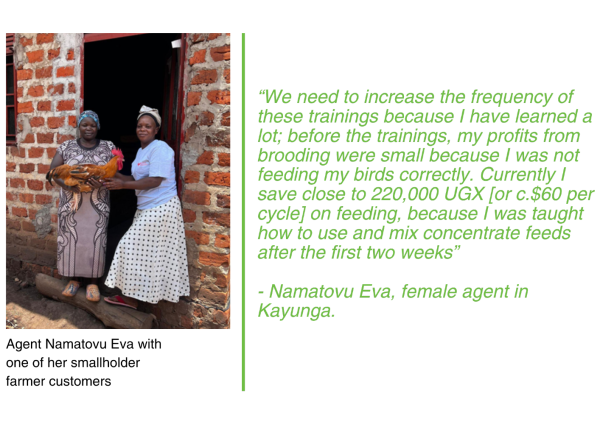
Both Transurban and Uzima have responded by bringing the training to them. Village-based models, run close to where women already live and work, have made participation possible for farmers who would otherwise have been left out, and the productivity gains have followed.
What comes next
AgDevCo's poultry portfolio continues to build on these lessons: sustaining farmer engagement well beyond initial training cycles and designing interventions that take women's barriers seriously rather than working around them. With ongoing support from businesses like Transurban and Uzima, smallholder poultry is doing what good rural enterprise should: improvements at farm level reverberating up the value chain, with farming families and agribusinesses both better off for it.
Ana's spare room is now a dedicated poultry shed. The next fifty chicks are already on order.
Read the full case study:
* Ana is not her real name but her story is true.